Kelowna's Residential Climate Control Masters
Don't Wait for the First Cold Snap — Why October Is the Right Time for a Furnace Inspection
It happens every year. The first genuinely cold night arrives in the Okanagan — usually sometime in October — and homeowners across the Okanagan turn on their furnace for the first time since spring. Most of the time, everything is fine. But some of those homeowners discover their furnace isn't working, or isn't working well, and now they need help urgently at the same time as everyone else in the valley.
The difference between a smooth start to heating season and a stressful one often comes down to one thing: whether you had your furnace inspected before you needed it.
Why Most People Skip the Inspection
Furnaces are easy to ignore when they seem to be working. If it heated your home last winter without any obvious problems, why spend money looking at it now?
It's a reasonable question — but it misses a few important realities.
First, furnaces don't usually fail dramatically. They degrade gradually. A heat exchanger develops a small crack. A burner gets dirty and starts running inefficiently. A safety control begins to wear. These issues often don't produce obvious symptoms right away — but they do affect performance, safety, and energy costs. By the time something fails completely, the problem has usually been building for a while.
Second, the inspection finds things you can't see or smell. A cracked heat exchanger is one of the most serious furnace problems — it allows combustion gases, including carbon monoxide, to mix with the air circulating through your home. It produces no obvious smell, no unusual sound, and no visible warning. It shows up on an inspection.
Third, October is when you have choices. If an inspection reveals your furnace needs a repair or a part, you have time to schedule it, source the component, and get it done before temperatures drop. If that same problem surfaces in January, you're dealing with it urgently, in the cold, competing with every other household that's in the same situation.
What a Furnace Inspection Covers
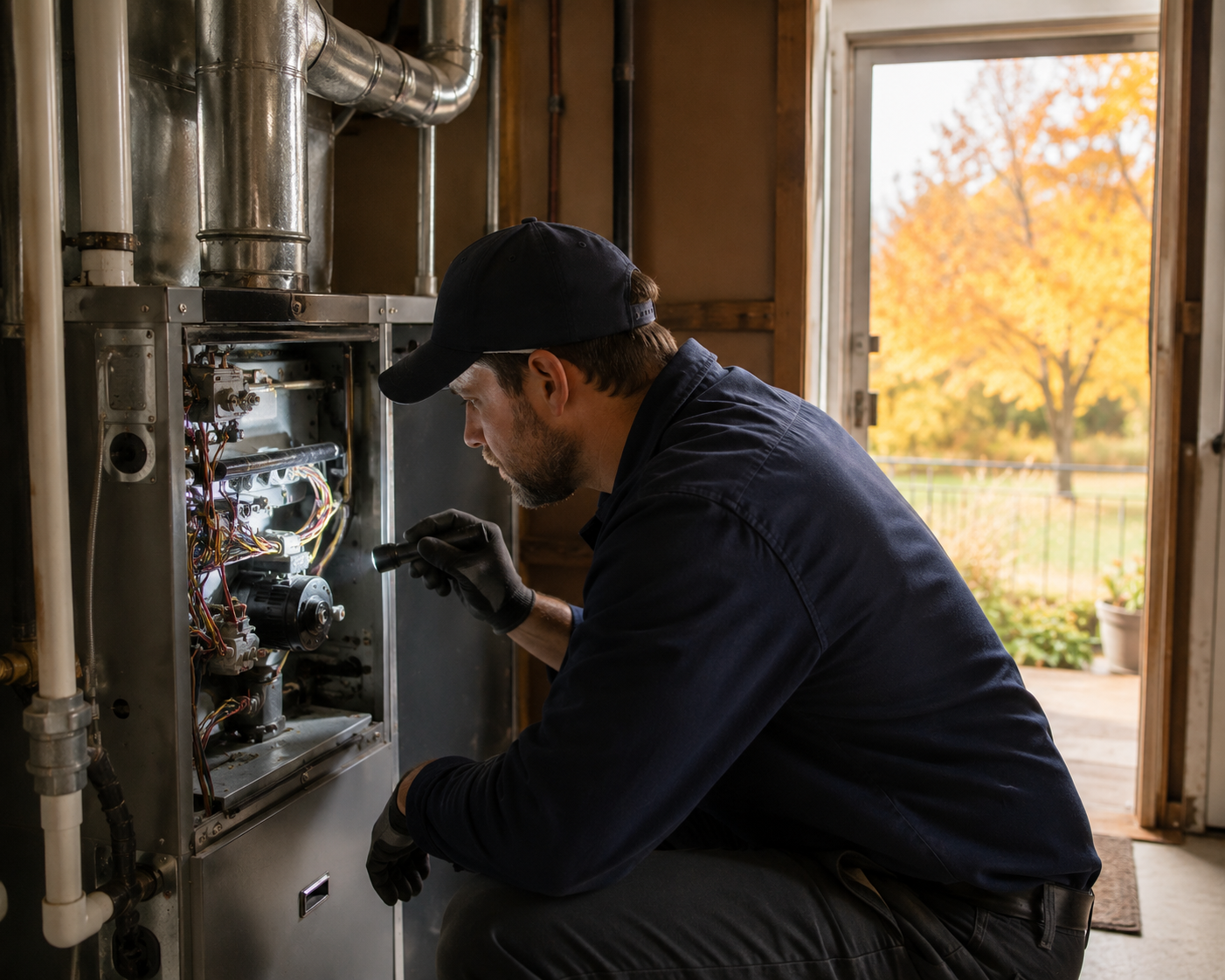
A professional furnace inspection isn't a quick visual check — it's a systematic evaluation of every major component. Here's what a qualified technician looks at:
Heat Exchanger
The heat exchanger is the component that separates combustion gases from the air your family breathes. Cracks or holes in the heat exchanger are a carbon monoxide risk. Inspecting it properly requires the right tools and training — it's not something a homeowner can assess reliably on their own.
Burners and Ignition System
Dirty burners affect combustion efficiency and can cause uneven heating or delayed ignition. The ignition system is tested to confirm it starts reliably. If your furnace has been hesitating on startup, this is usually where the answer is found.
Flue and Venting
The flue carries combustion gases — including carbon monoxide — out of your home. A blocked or deteriorating flue can allow those gases to back up into your living space. Technicians check for blockages, corrosion, and proper draft.
Blower and Motor
The blower circulates heated air through your ductwork. A worn blower motor runs less efficiently, distributes heat unevenly, and is likely to fail at the worst possible time. Belt-driven systems are checked for wear; direct-drive motors are tested for current draw and performance.
Safety Controls
Modern furnaces have multiple safety controls that shut the system down if something goes wrong — high-limit switches, pressure switches, flame sensors. These are tested to confirm they're functioning correctly. A failed safety control can prevent your furnace from running at all, or worse, allow it to run in an unsafe condition.
Filter and Airflow
A clogged filter restricts airflow, causes the system to overheat, and reduces efficiency. Technicians check the filter and assess overall airflow through the system.
Gas Pressure and Combustion
Gas pressure is measured to confirm it's within the manufacturer's specifications. Combustion analysis can identify whether the furnace is burning cleanly and efficiently — and flag issues that affect both performance and safety.
Carbon Monoxide: The Invisible Risk
Carbon monoxide is colourless, odourless, and produced by incomplete combustion in your furnace, fireplace, water heater, or any gas appliance. At low levels it causes headaches and fatigue that are easy to attribute to other causes. At higher levels it's fatal.
A cracked heat exchanger is one of the most common sources of carbon monoxide exposure in homes — and it's entirely preventable with a proper inspection.
If you don't have carbon monoxide detectors on every level of your home, install them before heating season starts. They're inexpensive and they're your last line of defence if something goes wrong between inspections. But they're not a substitute for having your furnace properly inspected — a detector tells you there's already a problem; an inspection prevents the problem from developing in the first place.
Why October — Not November
Every October, HVAC companies across the Okanagan see the same pattern: a steady flow of inspection and tune-up requests through September and early October, followed by a surge of urgent calls when the weather turns in late October and November.
Booking in October — ideally early October — means:
- More scheduling flexibility. You pick the time that works for you, not whatever's available.
- No urgency premium. Emergency or after-hours calls cost more. An inspection booked in advance doesn't.
- Time to address findings. If the inspection turns up a part that needs replacing, there's time to order it and schedule a follow-up without scrambling.
- Peace of mind heading into winter. Knowing your system has been inspected and is running safely is worth something on its own.
Waiting until November means competing with every other homeowner who also waited — and some of them are dealing with a furnace that's already stopped working.
What About Newer Furnaces?
A common assumption is that a newer furnace doesn't need an inspection. It's true that newer equipment is generally more reliable — but it still benefits from annual maintenance, and the inspection serves a different purpose depending on the age of the system.
For a furnace under five years old, the inspection is largely about confirming everything is running efficiently and catching any early signs of issues before they develop. For a system ten or fifteen years old, it's about assessing the condition of components that are approaching the end of their service life and making informed decisions about repair versus replacement before something fails.
Either way, the inspection gives you accurate information about what you're working with — rather than finding out mid-winter.
Book Your Fall Inspection Now
Macdonald Mechanical is booking fall furnace inspections now. We serve residential customers throughout the Okanagan, and our fall schedule fills up quickly once the cold weather arrives.
If you'd like to get your furnace inspected and tuned up before winter, give us a call or send us a message. We're happy to answer questions about your specific system and help you head into the colder months with confidence.
Contact us today at (250) 681-2600 or Macdonald.Mechanical.Inc@gmail.com.